
The European Dream Trap: 5 Counter-Intuitive Truths About the Nepalese Labor Crisis in Europe
11/26/2026
1. Introduction
For hundreds of thousands of South Asian workers, employment in Europe represents the ultimate ladder to economic mobility promising high wages, safe working conditions, and strong social protections. In recent years, Nepalese migrant workers have increasingly set their sights beyond traditional Gulf destinations and Malaysia, turning toward European nations such as Romania, Croatia, Bulgaria, Poland, Malta, Serbia, Portugal, Greece, Austria, and Cyprus.
However, beneath the promise of European prosperity lies a devastating structural trap. Driven by skyrocketing migration costs, an overwhelming reliance on informal brokers, and systemic oversight failures, thousands of migrants find themselves entrapped in severe financial distress and operational vulnerability.
Ironically, this crisis was not triggered by a lack of government intervention, but by state regulations intended to protect workers. By shutting down formal regulatory channels without addressing underlying global market demand, administrative decisions inadvertently opened the floodgates to an unregulated migration wave exposing workers to systemic fraud, contract breaches, and crippling debt traps.
2. Takeaway 1: The Policy Paradox How Government Protection Blew Open the Underground Market
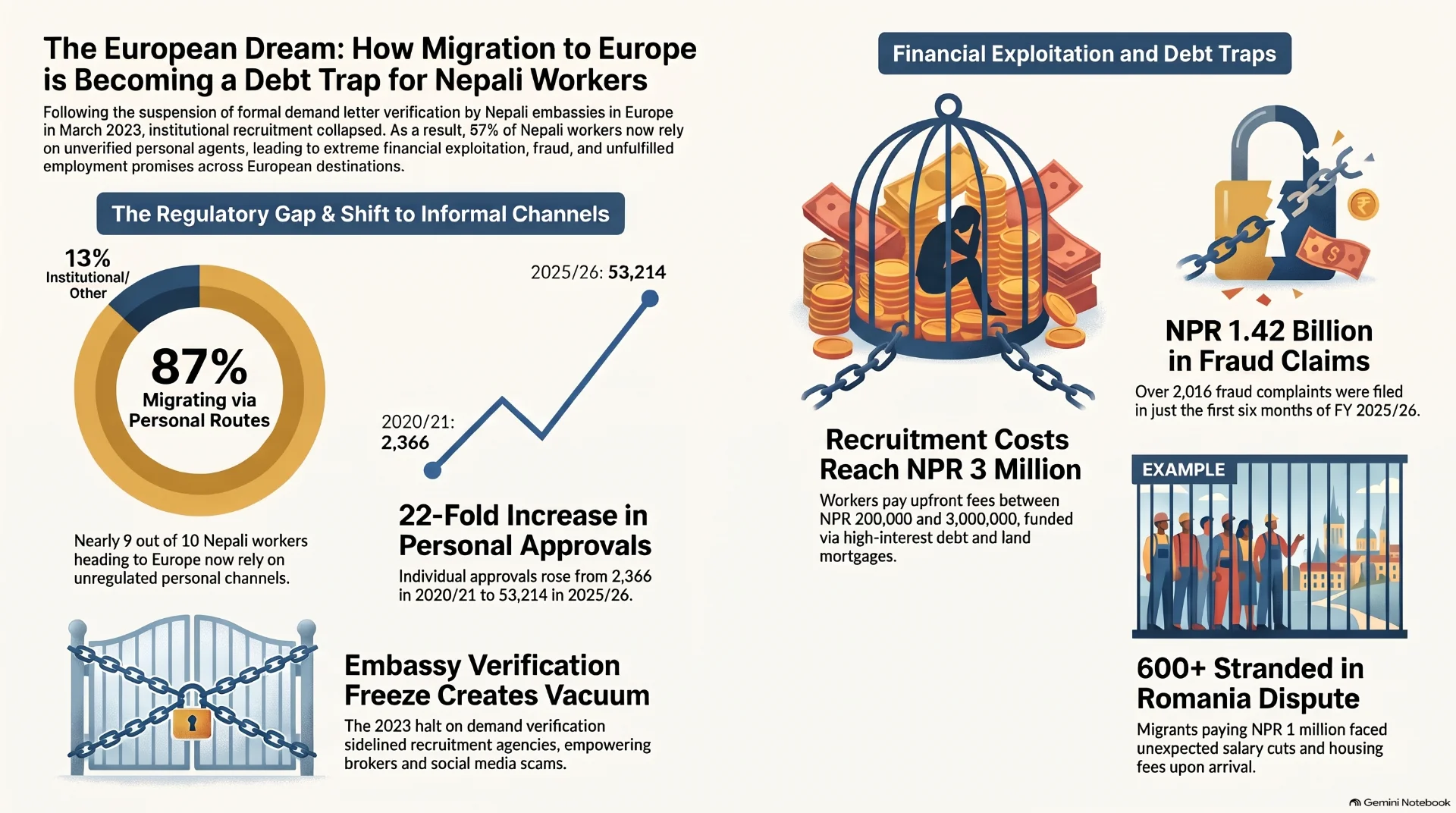
On March 8, 2023, the Nepalese government implemented a major regulatory decision: it suspended the verification of employer demand letters by Nepalese diplomatic missions across Europe. Under the Foreign Employment Act, 2064, institutional recruitment requires diplomatic missions to verify an employer's legitimacy, job nature, proposed salary, and workplace facilities before licensed manpower agencies can legally recruit workers. The government’s intent was protective to prevent workers from being stranded abroad, overstaying visas, or migrating illegally to secondary European destinations.
Instead, the decision backfired. With institutional manpower recruitment effectively frozen across nearly all of Europe (with the exception of Cyprus, which continued verification through the embassy in Israel), formal recruitment channels collapsed. Rather than halting the outflow of labor, the regulatory shutdown created an institutional vacuum. Informal individual agents, unregistered brokers, educational consultancies, and travel agencies quickly filled the void.
Metric
Pre-Policy Shift (2020/21)
Post-Policy Shift (Current)
Proportion of European Permits Issued via Personal/Unregulated Channels
49.2%
86.7%
Primary Recruitment Medium
Licensed Manpower Agencies
Informal Agents, Consultancies, Social Media
Explaining this structural failure, Dik Bahadur Khatri, President of the Nepal Foreign Employment Association (नेपाल वैदेशिक रोजगार व्यवसायी संघ), highlighted how the suspension paralyzed legitimate agencies while empowering unmonitored actors:
"As long as demand letters are not verified, licensed manpower agencies cannot send workers under their official responsibility. The ability of workers to obtain authentic information regarding job descriptions, salaries, facilities, employer credibility, and destination laws has been severely undermined. Informal individual agents, unregistered brokers, educational consultancies, and travel agencies stepped directly into this void advertising lucrative salaries on Facebook, TikTok, WhatsApp, and Messenger, showing fake demand letters and visas to extort money."
Without state-verified pathways, nearly nine out of every ten Nepalese workers heading to Europe now do so without the backing, oversight, or legal protection of licensed agencies. Analyzing this systemic collapse, Jeevan Baniya, Research Director at the Center for the Study of Labor and Mobility (CESLAM), captured the underlying policy paradox:
"सरकारले नियमन गर्न खोजेको आप्रवासनको क्षेत्र नै नियमनको पहुँचभन्दा बाहिर जान थालेको छ।" (Translation: "The very migration sector the government sought to regulate is slipping beyond the reach of regulation.")
3. Takeaway 2: The 22-Fold Surge Demand for Europe Exploded Despite Sky-High Costs
Despite the suspension of institutional channels and official safeguards, the appetite for European jobs reached unprecedented levels. Data from the Department of Foreign Employment reveals a staggering growth trajectory: personal labor permits issued for Europe grew from just 2,366 in 2020/21 to 53,214 in the partial period of 2025/26 a 22-fold increase in just five years.
Europe’s share of Nepal's total labor permits rose from roughly 3% in 2020/21 to nearly 8% in 2024/25, with 32,268 permits issued in 2024 alone. In total, 83,060 Nepalese workers received labor permits for Europe between 1990 and 2024.
Personal Labor Permits Issued for Europe (2020/21): 2,366 permits
Personal Labor Permits Issued for Europe (2025/26 partial): 53,214 permits (22-fold increase)
European Share of Total Permits: ~3% (2020/21) to ~8% (2024/25)
This migration boom is fueled by real structural forces: European nations facing demographic declines have severe labor shortages in healthcare, hospitality, construction, and services. However, because institutional pathways where European employers often cover visa fees and airfare were blocked by Nepalese policy, the entire financial burden was transferred onto the workers.
To secure entry through informal, individual channels, workers must fund everything out-of-pocket:
Standard Informal Broker Fees: NPR 2 lakh to NPR 15 lakh ($1,500 – $11,000+ USD).
Complex Multi-Country Routes: Up to NPR 30 lakh ($22,000+ USD) for complex migration paths.
To raise these immense sums, workers mortgage family land, borrow from relatives, or take on high-interest loans from private lenders, saddling themselves with crippling financial liability before ever stepping foot in Europe.
4. Takeaway 3: The Micro-Dispute Trap How 10 Lakh Rupees of Debt hinges on a $60 Hostel Fee
The vulnerability of unverified migration is vividly illustrated by an ongoing crisis in Romania, where more than 600 Nepalese workers face sudden unemployment, loss of shelter, and potential deportation over minor contract discrepancies.
The workers arrived in Romania after paying approximately NPR 10 lakh (~1 million NPR) each to an agency in Nepal, Time Management Pvt. Ltd., before being assigned to various host companies by Visar Logistics Pvt. Ltd.
Contract Parameter
Contract Promised in Nepal
Reality Upon Arrival in Romania
Net Monthly Impact
Base Monthly Salary
2,699 Romanian Leu
2,455 Romanian Leu
-244 Leu
Hostel Accommodation
Free
300 Leu Deduction (~$65 USD)
-300 Leu
Total Monthly Deficit -544 Romanian Leu
Upon arrival, the workers discovered two major violations of their original agreements: their base monthly salary of 2,699 Romanian Leu was arbitrarily reduced to 2,455 Leu, and employers demanded a monthly deduction of 300 Leu for hostel accommodation that had been explicitly promised as free.
When the workers protested these illegal wage cuts and fee deductions by halting work, the employer responded with an ultimatum: resume work under the reduced wages or face immediate eviction from the hostel. In Europe's strict labor and immigration frameworks, losing employer placement often triggers immediate loss of legal residency status and housing. Trapped between illegal wage deductions abroad and high-interest debt at home, these 600 workers remain stranded, appealing to the Nepalese government and embassy for intervention.
5. Takeaway 4: Tech-Enabled Recruitment Fraud is Reaching Billion-Rupee Scales
The elimination of verified recruitment agency channels has allowed sophisticated digital scams to flourish. Operating outside the Foreign Employment Act, unregulated brokers use social platforms like TikTok, Facebook, WhatsApp, and Messenger to broadcast advertisements featuring fraudulent demand letters, fake visas, and guaranteed jobs.
Brokers exploit language barriers to deceive applicants. For instance, 36-year-old Rajesh Karki from Ramechhap paid NPR 2,46,500 to Kozmo Consultancy after being promised a work visa in Bulgaria. The consultancy provided official-looking work permits written in Bulgarian. Lacking verified English translations, Karki attempted to decipher his work permit using Google Translate. Kozmo Consultancy subsequently absconded after defrauding roughly 300 prospective migrants of NPR 7.5 crore (75 million NPR). As Karki noted, because consultancies operated openly without visible state intervention, applicants assumed the process was legal and verified.
The Department of Foreign Employment reports an escalating wave of formal fraud complaints across foreign employment sectors over recent fiscal years:
2020/21: 780 complaints
2021/22: 1,742 complaints
2022/23: 4,464 complaints
2023/24: 7,663 complaints
2024/25: 5,632 complaints
2025/26 (First 6 Months Only): 2,016 formal complaints claiming over NPR 1.42 billion (1.42 arba NPR) in total losses.
Navaraj Dhakal, Director General of the Department of Foreign Employment, emphasized that investigating personal recruitment fraud is exceptionally difficult. Because financial transactions occur informally via personal contacts without official receipts, victims are left with limited legal recourse and complex paths to restitution.
6. Takeaway 5: The "Debt Run" Failed European Dreams Drive Secondary Illegal Migration
When European jobs fail to materialize or contracts are breached, migrant workers face unbearable economic pressure. Carrying high-interest debt back home, returning to Nepal empty-handed is financially impossible. This reality forces workers into secondary, illegal cross-border migrations within Europe to maintain earning capacity.
This cycle is illustrated by the case of Arjun Gurung from Lamjung. Gurung paid NPR 8 lakh to secure a promised packing job in Croatia. Upon arriving, he found no job, no income, and no legal support system. Facing mounting debt pressures from home, he was forced to flee illegally across European borders into Greece to search for work in the informal economy.
"काम नपाउने भएपछि अहिले ग्रीस आइपुगेको छु । टाउकामा थप ऋणको भारी छ । युरोप आउनु नै पछुतो लागिरहेको छ । पुर्पुरो समाएर मात्रै नहुँदो रहेछ ।" (Translation: "After not getting work, I have now reached Greece. There is an additional burden of debt on my head. I regret coming to Europe. Just holding your forehead in regret doesn't help.")
Gurung’s experience highlights how failed formal entries transform into long-term legal and economic precarity. To service high-interest loans taken out in Nepal, workers are forced into undocumented labor networks across Europe, compounding their legal exposure and vulnerability to human trafficking.
7. Conclusion & Forward-Looking Thought
The crisis facing Nepalese workers in Europe underscores a fundamental governance failure: attempting to protect workers by suspending administrative verifications did not stop migration it simply removed state oversight, paralyzed licensed agencies, and handed control over to informal brokers.
A severe policy deadlock currently stalls reform within the Nepalese government:
The Ministry of Labor, Employment and Social Security: Led by Minister Ramji Yadav, the ministry maintains that foreign employment cannot be halted outright. Ministry Spokesperson Meera Acharya advocates for immediately reopening employer demand letter verifications to restore safe, dignified, and systematic recruitment.
The Ministry of Foreign Affairs: Ministry Spokesperson Lok Bahadur Poudel Chhetri contends that verification should not resume without thorough policy and technical preparation. Foreign Affairs insists on preliminary field studies by high-level task forces in destination countries and full digital integration between the Department of Consular Services and the Department of Foreign Employment online systems before reopening verification.
While ministries debate administrative procedures and technical readiness, thousands of Nepalese workers remain exposed to extortion, wage theft, and illegal secondary migration.
A Thought-Provoking Question: When market demand for global labor is high, should governments rely on rigid bans and procedural suspensions that fuel underground exploitation or should they build agile, responsive oversight systems designed to protect vulnerable citizens seeking a better life?