
Zero-Cost Migration vs. Private Enterprise: 4 Insightful Takeaways from Nepal’s Mauritius Labor Controversy
11/2/2026
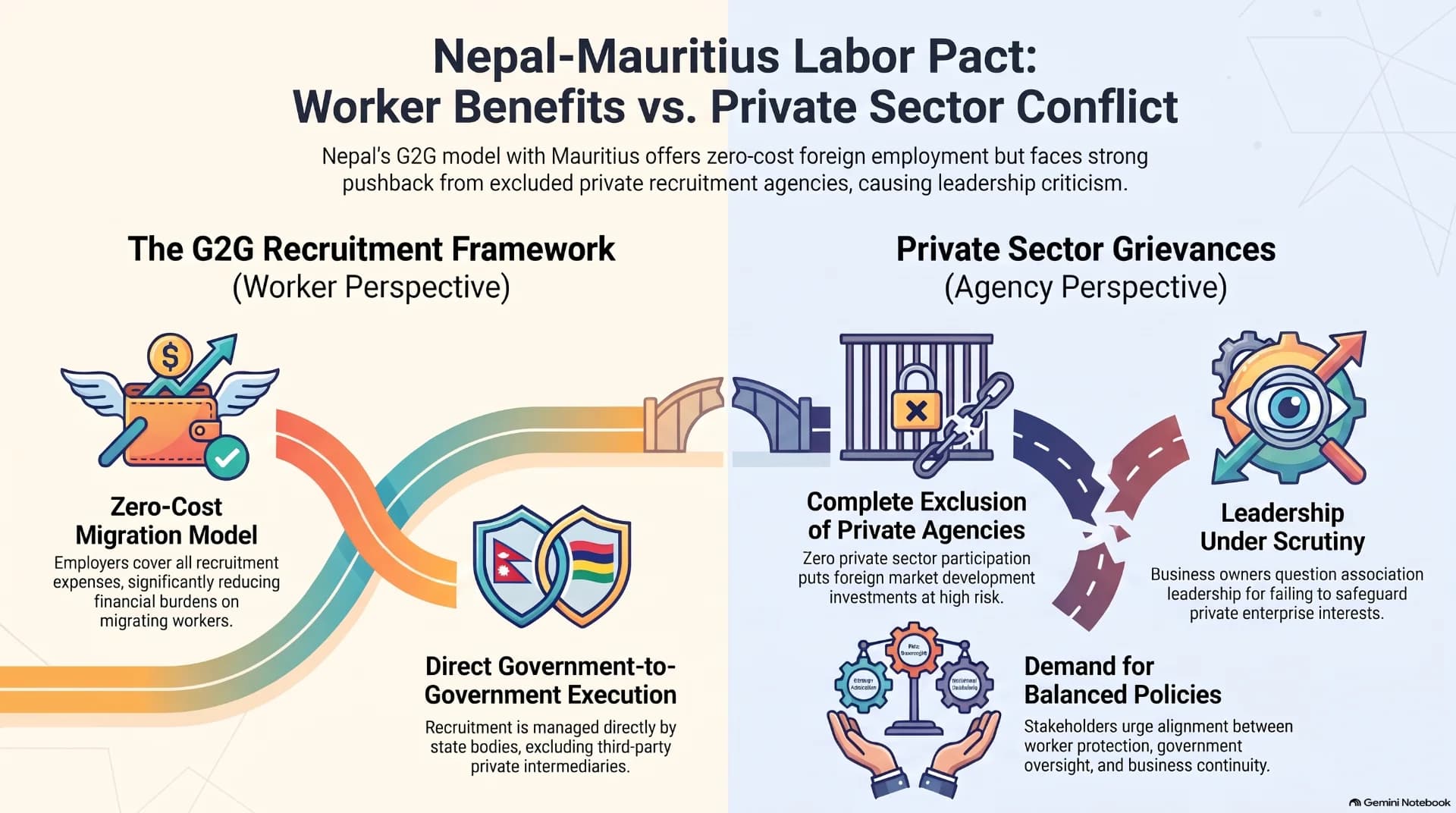
When state policies pivot to protect vulnerable overseas workers, even the most noble reform can ignite intense structural friction across the labor ecosystem. Nepal’s latest foreign employment push into Mauritius perfectly captures this policy paradox: a breakthrough victory for migrant rights has simultaneously triggered an existential crisis and a fierce leadership rebellion within the domestic recruitment industry.
At the center of this controversy is the government's negotiation of a direct Government-to-Government (G2G) agreement with Mauritius built upon the "Employer Pay Model" (इम्प्लोयर पे मोडल). By transferring recruitment costs to destination employers, the state has secured a zero-cost corridor for Nepali workers. Yet, by locking out private recruitment agencies entirely, the policy has sparked severe institutional backlash and exposed deep fault lines between state intervention, private enterprise, and executive leadership within the Nepal Foreign Employment Association (नेपाल वैदेशिक रोजगार व्यवसायी संघ).
For public policy analysts, the Mauritius debate offers a compelling case study on the fragile economics of labor migration. How can developing nations scale ethical, zero-cost migration frameworks without systematically dismantling the private market infrastructure that discovered and established these overseas destinations in the first place?
Takeaway 1: The Zero-Cost Migration Paradigm Shift
The bilateral labor arrangement between Nepal and Mauritius represents a major watershed in structural migration reform. At its core, the deal codifies the "Employer Pay Model" (इम्प्लोयर पे मोडल) within an explicit Government-to-Government (G2G) mechanism. Under this framework, foreign employers in Mauritius absorb the full spectrum of recruitment, transportation, and administrative expenses, enabling Nepali citizens to secure international job placements at zero or minimal personal cost.
From a labor economics perspective, this model directly targets the chronic market failure of debt-financed migration. Traditional recruitment pipelines frequently force low-wage workers to take on predatory, high-interest loans to cover upfront recruitment fees, effectively tethering their future earnings to debt service before they even board a flight.
By replacing high-fee private intermediaries with state-negotiated zero-cost guarantees, the Nepal-Mauritius agreement demonstrates how targeted G2G frameworks can dismantle exploitative cost structures, enforce progressive labor standards, and lower entry barriers for vulnerable job seekers.
Takeaway 2: The Exclusion Paradox – Zero Private Sector Participation
While the human rights gains of zero-cost migration are clear, the execution of the Mauritius deal has laid bare a profound policy dilemma: the complete exclusion of private recruitment agencies. Manpower entrepreneurs voice deep frustration over finding their participation reduced to zero the moment high-potential government agreements are finalized.
This tension speaks to a core dynamic in labor market development. Private recruitment firms routinely operate as venture explorers—spending millions of rupees in private capital to explore unfamiliar geographic destinations, build international employer networks, and open new labor corridors. However, once those markets are proven viable, state-led G2G initiatives risk nationalizing the pipeline, displacing the very private enterprise that invested to build the market.
This grievance reflects broader structural anxieties across Nepal's foreign employment sector, echoing ongoing disputes over agency quotas and market access in major corridors like Malaysia—where debates over restricted agency frameworks, such as the 25 PRAS (Private Recruitment Agencies) and 250 ARS (Approved Recruitment Agencies) arrangements, have highlighted persistent fears of syndicate control and state-enforced exclusion.
As private agency representatives emphasized regarding the government's current trajectory:
"While the government's decisions in favor of workers are welcome, worker welfare and the existence of the private sector should not be pitted against each other."
Takeaway 3: Leadership Under Fire – The Association’s Crisis of Confidence
The complete exclusion of manpower agencies from the Mauritius labor pipeline has touched off a firestorm of accountability directed at the leadership of the Nepal Foreign Employment Association (नेपाल वैदेशिक रोजगार व्यवसायी संघ). Grassroots entrepreneurs are openly confronting institutional leaders, accusing them of passivity and ineffective lobbying while the state drafted deals that sidelined licensed agencies.
Agency owners are pressing association leadership for concrete answers to three critical operational questions:
What specific initiatives and formal steps did association leadership execute to safeguard private capital and existing market investments during G2G negotiations?
What concrete policy alternatives were submitted to ensure business continuity and operational roles for licensed agencies?
How aggressively did leadership advocate to retain private sector participation alongside state-enforced worker protection standards?
This internal revolt highlights a growing divide between institutional elite representatives and frontline manpower entrepreneurs. Grassroots agency owners argue that while leadership engages in high-level discussions, their real-world financial investments and market-building efforts are systematically sacrificed to expanding state monopolies.
Takeaway 4: The Delicate Triad – Worker Rights, State Policy, and Commercial Survival
The overarching analytical lesson from the Mauritius dispute is that long-term labor migration policy cannot rely on single-variable solutions. A resilient, sustainable foreign employment strategy depends on maintaining a delicate equilibrium across three interdependent pillars: migrant worker welfare, protective state regulation, and private sector commercial viability.
Distorting any single pillar destabilizes the entire labor market ecosystem. Migrant workers require fair, debt-free, and safe avenues to global employment; the state must formulate strong regulatory guardrails to prevent exploitation; and private recruitment agencies require predictable, legal access to commercial opportunities proportionate to their capital investments and operational capacity.
Underscoring the long-term risk of policy frameworks that treat commercial enterprise as collateral damage, private recruiters warn:
"The trend of exploring new destinations, investing millions, and expanding the market, only to be excluded when opportunities arise, puts the future of entrepreneurs in peril."
Navigating the Future of Fair Recruitment
Nepal’s Mauritius labor controversy serves as a microcosm of the broader tensions defining global migration policy. The shift toward an "Employer Pay Model" (इम्प्लोयर पे मोडल) via G2G channels marks an essential victory for ethical recruitment and worker protection. Yet, doing so by marginalizing private recruitment agencies creates market instability, disincentivizes private investment in destination expansion, and fuels intense political friction within industry bodies like the Nepal Foreign Employment Association (नेपाल वैदेशिक रोजगार व्यवसायी संघ).
Sustainable policy reform must avoid zero-sum choices that pit ethical standards against commercial survival. As developing nations look to expand zero-cost migration channels, public policy makers face a crucial structural question: Can governments design ethical, state-regulated labor agreements that protect vulnerable workers without completely dismantling the private enterprise network that builds and sustains international market demand?