
Beyond the Gulf: Surprising Realities of Nepal’s Global Labor Map
5/5/2026
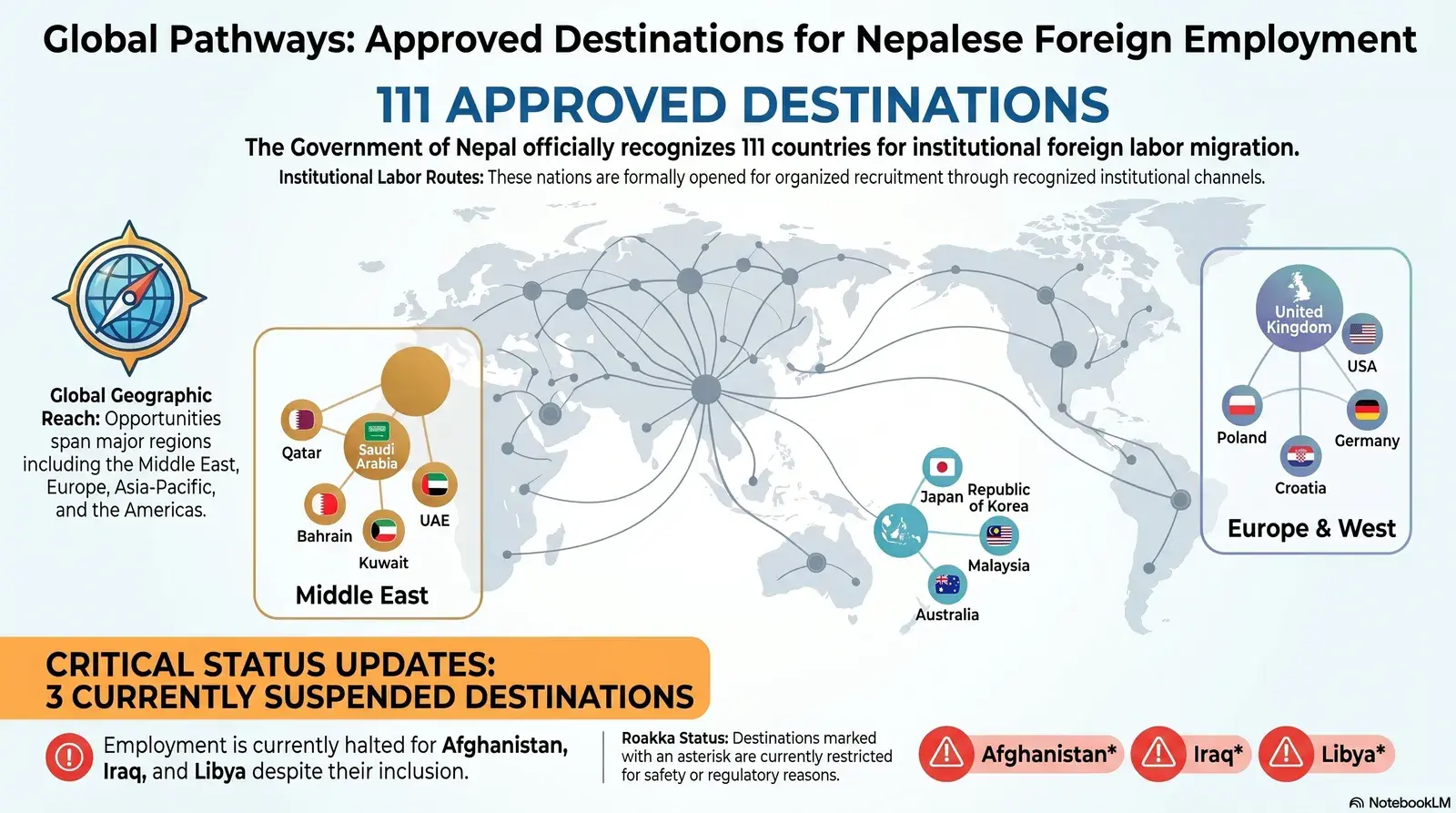
The prevailing narrative of Nepalese labor migration is one of geographical concentration, dominated by the dusty construction sites of the Gulf and the sprawling factory floors of Malaysia. For years, these corridors have defined the socio-economic identity of the country’s diaspora. However, a closer look at official data reveals that Nepal is aggressively charting a far more expansive and eclectic global footprint than public perception allows.
The Government of Nepal has formally sanctioned 111 distinct destinations for institutional foreign employment. This figure represents more than just a list of names; it signals a strategy of radical global engagement. From the smallest sovereign enclaves to the most remote corners of the South Pacific and the Andes, the Nepalese workforce is no longer a regional labor pool, but a truly global one.
1. A Global Footprint Spanning 111 Nations
The scale of Nepal’s authorized labor map comprising 111 nations shatters the myth of a "handful of hubs." This breadth indicates a workforce and a state apparatus that have successfully navigated the complexities of international labor law across six continents. This is a diversifying economic strategy in action, one that seeks to mitigate regional risks by spreading human capital across a vast geopolitical spectrum.
The scope of this outreach is codified in the government’s foundational document:
"Official List of Approved Destinations for Nepalese Foreign Employment: List of countries open for foreign employment institutionally by the Government of Nepal."
2. From the Vatican to the Andes: Navigating the Unexpected
The geography of this list defies conventional logic, moving well beyond traditional industrial centers to include some of the world’s most counter-intuitive destinations. Perhaps most striking is the inclusion of "Holysee" (the Vatican), the world’s smallest sovereign state, suggesting that the reach of the Nepalese workforce extends even into the heart of the Roman Catholic administration.
The map further expands into South America, listing "Bolevia" (Bolivia) and "Venezuala" (Venezuela). To find Nepalese labor routes authorized for countries on the literal opposite side of the planet nations that are themselves navigating profound economic shifts speaks to a remarkable level of institutional ambition. This global reach is further punctuated by the inclusion of "Iceland" in the far north and the maritime isolation of "Fiji" and "Sychelese" (Seychelles). By authorizing employment in these remote island nations and polar reaches, Nepal has effectively removed "distance" as a barrier to its labor aspirations.
3. The Asterisk: Geopolitical Boundaries of Opportunity
While the list suggests an "open door" policy, three specific entries carry a sobering administrative caveat. Afghanistan, Iraq, and Libya are each marked with an asterisk, denoting the status: “हाल रोक्का गरिएको” (Currently prohibited).
This asterisk represents the volatile intersection of economic opportunity and physical security. While these nations remain on the "approved" list as institutional destinations, the state has been forced to intervene, halting migration due to conflict and instability. For a labor trends analyst, these prohibited entries serve as a reminder that the global labor map is living and breathing, constantly reshaped by the state’s responsibility to protect its citizens from the very "opportunities" it has sanctioned.
4. The European Pivot and African Frontiers
One of the most significant trends evidenced by the list is the move away from traditional Asian saturation toward new "regulatory frontiers" in Eastern Europe and Africa. Nepal is increasingly eyeing the labor-starved markets of post-communist Europe, specifically authorizing corridors into "Albenia" (Albania), "Crotia" (Croatia), "Serbia," and "Rumenia" (Romania).
This pivot to Europe is strategic; these markets often provide different legal protections and economic implications compared to the Kafala-driven systems of the Middle East. Simultaneously, the list identifies a burgeoning African frontier, including "Congo," "Uganda," "Zambia," and "Nigeria." These entries suggest that as traditional markets reach their limit, Nepal is proactively diversifying its labor exports into developing economies across the African continent, seeking first-mover advantages in emerging sectors.
5. Administrative Artifacts: The Orthography of Migration
The list is not merely a data set; it is a localized administrative artifact with its own distinct character. This is most visible in the unique orthographic choices used for several destinations. The document specifically lists "Luxzemburg," "Mecedonia," "Moritius," and "Guana" (Guyana).
These are not mere typos to be corrected by international standards; they are the official spellings used within the Nepalese administrative context. These linguistic nuances underscore the localized nature of migration management. They remind us that the global flow of people is governed by specific, often idiosyncratic, national institutions that process the world through their own unique terminologies.
The Human Element of the Map
As we analyze these 111 destinations, it is easy to lose sight of the individual beneath the data. Yet, each entry from "Iceland" to "Bolevia" represents a potential life-altering journey. The expansion of this map reflects a nation that is no longer content with being a regional labor source for its neighbors.
The reach of the Nepalese worker now spans the smallest city-states and the most distant archipelagos. When we look at this map, we must ask: Do we see a list of 111 countries, or do we see 111 different ways a life can be transformed and the profound risks and rewards that come with charting such a journey?