
The Hidden List: Protecting Your Future Abroad from Blacklisted Employers
5/5/2026
The Hook: The Reality of the Global Dream
For thousands of Nepali citizens, the prospect of overseas employment is the cornerstone of upward mobility, often representing the only viable path to financial solvency. Yet, within the complex architecture of bilateral labor agreements and cross-border migration, the "Global Dream" can quickly devolve into a nightmare of predatory recruitment and exploitation. In this high-stakes environment, the Nepal Department of Foreign Employment (DoFE) serves as a vital institutional gatekeeper, providing a thin but essential line of defense for the nation's labor force.
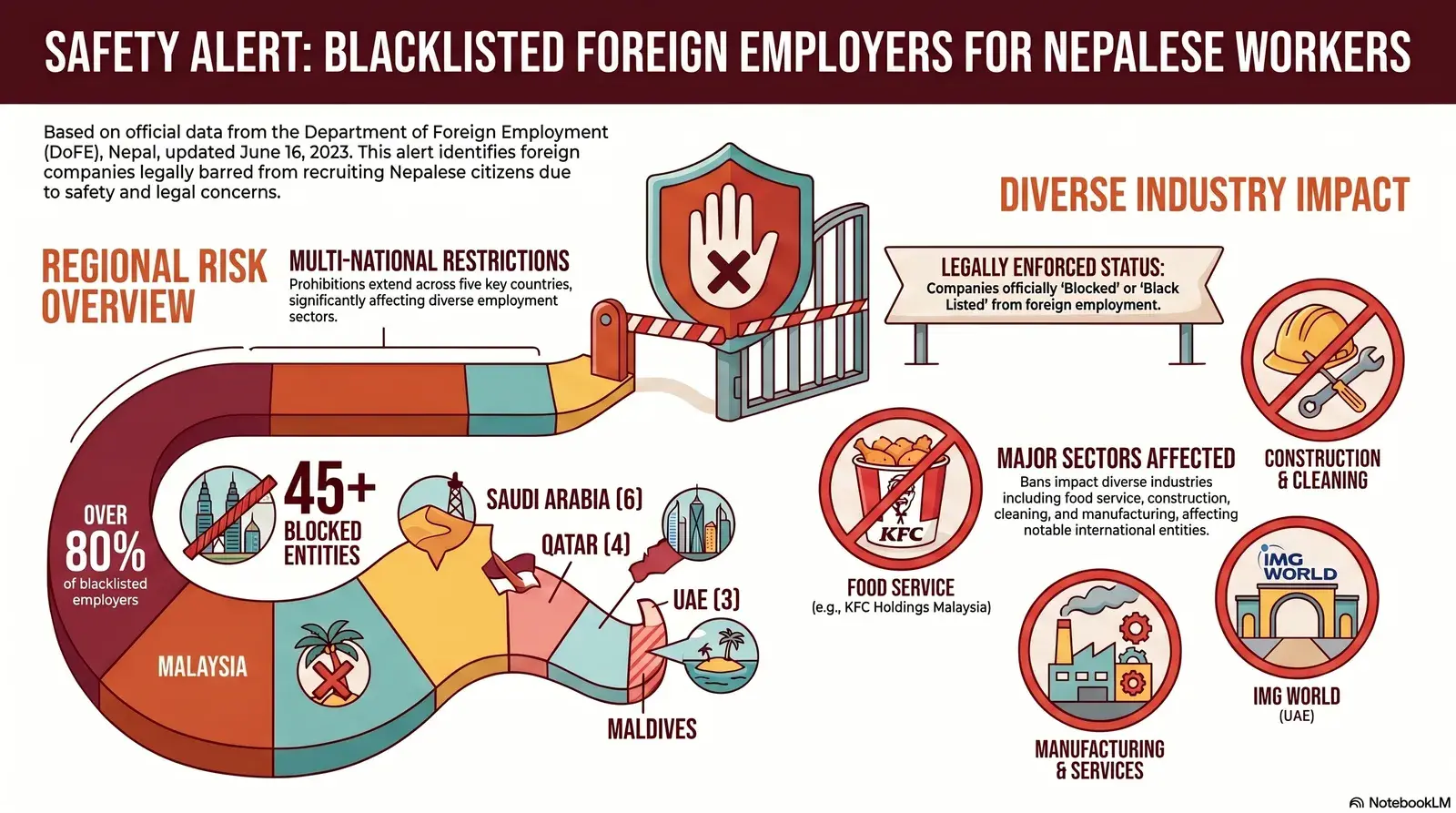
A critical instrument in this regulatory oversight is the "List of Foreign Employers Blocked for conducting foreign employment in Nepal." Updated as of June 16, 2023, this registry identifies specific entities that have been legally prohibited from engaging in recruitment activities within Nepal. For the prospective migrant, this list is not merely a bureaucratic record; it is an essential due-diligence tool. Ignoring its warnings means operating outside the protection of the law and entering a professional engagement where the government of Nepal has already signaled a red flag.
Malaysia as the Geographic Epicenter of Risk
An empirical analysis of the DoFE data reveals that Malaysia remains a high-density zone for regulatory intervention. The overwhelming majority of blocked entities are concentrated within this specific migration corridor, clustered around the country’s industrial and commercial hearts. For a Nepali worker, a job offer in these regions carries a statistically higher risk of involving a prohibited entity.
The geographic spread highlights several high-risk hubs:
Kuala Lumpur/Kualalumpur: The capital and its surrounding areas show heavy listing, including Konsortium Pasar Borong Sdn.Bhd. (S.N 2) and Pine Jati coproration SB (S.N 3).
Selangor: As the industrial powerhouse of the nation, it contains numerous blocked firms such as C S Metal Industries (M) SB (S.N 14) and HLH Wood Industries SB (S.N 19).
Johor: This southern manufacturing belt includes entities like Maxlin Garments SB (S.N 6) and Perdana Cleaning Services (S.N 11).
Perak: Regional industrial entries include Choon Kee Woodworks SB (S.N 16) and RNE Consortium SB (S.N 31).
The concentration of these listings suggests that the very areas most attractive to migrant labor are also those most prone to regulatory breaches. As the official record states:
"List of Foreign Employers Blocked for conducting foreign employment in Nepal by Department of Foreign Employment"
Household Names are Not Exempt
One of the most dangerous fallacies in migration policy is the assumption that brand recognition is a proxy for regulatory compliance. Prospective employees often believe that multi-national franchises or established corporate groups are inherently "safe." However, the DoFE list dismantles this notion by including major corporate entities and international brands.
The June 2023 update specifically identifies:
K.F.C. Holding Malaysia (S.N 9) notably listed at the erratically spelled "Qualalumpur."
KFC Holdings (Malaysia) Bhd (S.N 10) listed with a specific fax number in Kuala Lumpur.
The inclusion of these entities, complete with the bureaucratic inconsistencies in the Department’s own data entry (such as the spelling of "Qualalumpur"), serves as a warning that no amount of corporate prestige excuses a worker from verifying an employer's legal standing. A brand may be global, but its recruitment practices are still subject to local "Blocked" statuses that carry serious legal weight.
The Persistence of "Repeat Offenders"
A sophisticated understanding of the blacklist reveals a pattern of persistence among certain employers. Some entities appear to utilize slight nomenclature variations and phonetic misspellings to potentially circumvent database searches or regulatory tracking—a tactic common in sectors with poor oversight.
Konsortium Pasar Borong SB serves as the primary case study for this persistence, appearing five times with subtle shifts:
Konsortium Pasar Borong Sdn.Bhd. (S.N 2) and Konsortium Pasar Borong SB. (S.N 4) in Kuala Lumpur.
Cansortium Pasar Barang (S.N 46) a critical phonetic variation listed in "Kl" that could easily be missed in a standard search.
Furthermore, the lack of precise data at the source can be a red flag. For instance, Konsortium entries at S.N 5 and S.N 7 list the address simply as "Jalan" (the Malay word for "street"), providing no verifiable location. This ambiguity, combined with the "clutter" created by similar-sounding names like M10 Builders SB (S.N 26), M-Io Building Sdn Bhd (S.N 48), and M-IO Builders Sdn Bhd (S.N 49), demands that workers check every character and serial number with surgical precision.
A Multitude of Sectors Under Scrutiny
Regulatory risk is not localized to construction or heavy labor; it permeates the entire employment spectrum. The DoFE list shows that enforcement actions are particularly frequent in service-oriented sectors where workers are often the most vulnerable and have the least recourse.
Key sectors currently under scrutiny include:
Cleaning Services: This high-risk sector includes Pangilma Intan Cleaning Services SB (S.N 8 listed at "Kaala Lumpur"), Perdana Cleaning Services (S.N 11), Kok Heng Cleaning Service (S.N 38), and GLC Cleaning & Maintenance (S.N 45).
Manufacturing and Garments: Entries such as Maxlin Garments SB (S.N 6), C S Metal Industries (M) SB (S.N 14), and Selangor Cotton Towels Mfg. SB (S.N 33) show risks in the textile and metal sectors.
Specialized Woodwork: Significant listings include Choon Kee Woodworks SB (S.N 16), HLH Wood Industries SB (S.N 19), and Manchu Wood Industries (S.N 40).
Security: Firms like AHM Consultancy & Security Services SB (S.N 12) and X Cops Security Services and Solutions (S.N 65) are blocked, representing a sector where labor rights are historically difficult to enforce.
The GCC and Beyond A Broad Reach of Enforcement
While Malaysia dominates the list in volume, the DoFE maintains a broad reach of enforcement across the Gulf Cooperation Council (GCC) and other regions. A "Blocked" status is a universal signal of concern that transcends a host country's wealth or geographic location.
Significant prohibited entities outside of Malaysia include:
Qatar: Qatar Arab Contractors Ltd. Co. (S.N 54), Khalid Bin Fahd Trading & Contracting Co. (S.N 55), TEAMWORK CONTRACTING AND REAL ESTATE (S.N 59), and Almaa Al Raqee Trad. Cont. Cleaning (S.N 64).
Saudi Arabia: Saeed Hadi Al-Dossary Establishment for Contracting (S.N 56), EASTERN HERITAGE G. CONTRACTING & G. CLEANING & PEST CONTROL (S.N 57), Joud Al Wafa Maintenance, Cleaning And Operating Est (S.N 58), AL-YAMAMA COMPANY FOR TRADING AND CONTRACTING (S.N 60), and FAHAD BIN ATIA MANEE ALMUTAIRI EST (S.N 61).
United Arab Emirates (UAE): Al Hamed Development Construction Company (S.N 1), IMG World and Adventure (S.N 62), and Habas General Maint. Contra. LLC (S.N 63).
Maldives: X Cops Security Services and Solutions (S.N 65).
Regardless of whether the employer is a construction giant in Dubai or a cleaning service in Doha, if they appear on this list, any recruitment effort targeting Nepali citizens is a violation of established labor policy.
Conclusion: Moving Forward with Caution
The "List of Foreign Employers Blocked for conducting foreign employment in Nepal" is an indispensable resource for anyone navigating the complexities of global labor migration. As this analysis shows, the landscape of risk is dynamic, encompassing everything from household brands to repeat offenders who hide behind phonetic misspellings.
As of the June 16, 2023 update, the message from the Department of Foreign Employment is clear: any recruiter offering placement at these firms is operating outside the law. It is the responsibility of the prospective worker to consult these official records before a single document is signed or a single rupee is paid. In the rush to secure a better future, can we afford to overlook the warnings already written in the fine print?