
Your Dream Job Abroad Could Be a Legal Nightmare: 4 Red Flags from the DoFE You Can’t Ignore
4/23/2026
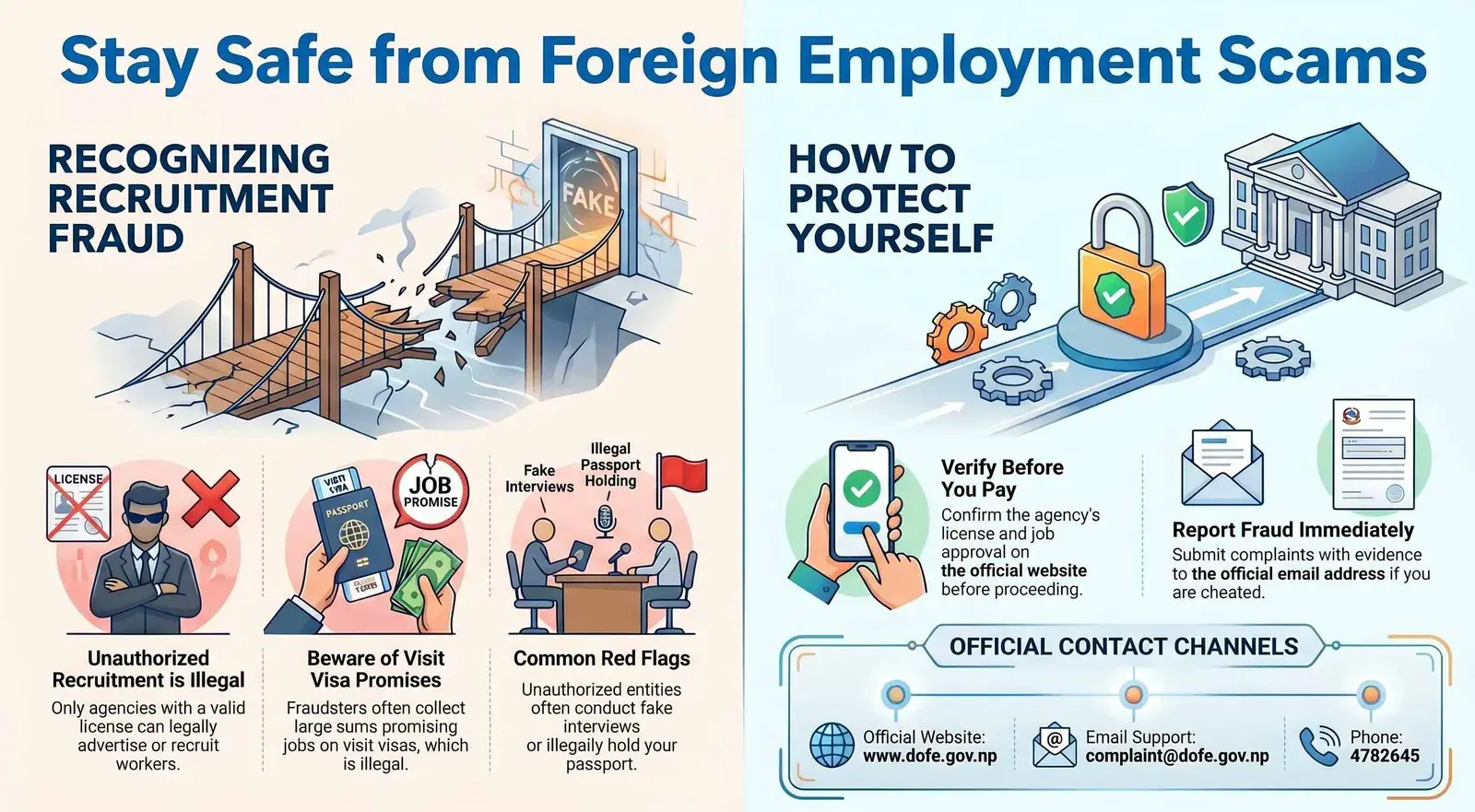
1. Introduction: The High Stakes of the Global Job Hunt
The ambition to secure a better life across borders is a universal driver of human progress. For thousands of Nepalis, foreign employment is not just a career choice it is a lifeline for their families and a blueprint for a prosperous future. However, this desperate pursuit of opportunity has created a thriving ecosystem for predatory actors who profit from shattered dreams.
As an investigative journalist who has tracked the fallout of labor trafficking for years, I’ve seen how scammers evolve their tactics. To cut through the noise, the Department of Foreign Employment (DoFE) has issued a critical warning dated 2082/12/15. This isn't just another government memo; it is a definitive field guide for anyone looking to navigate the dangerous waters of international recruitment. Ignoring these red flags doesn't just risk your savings it risks your freedom.
2. The Interview Trap: When Even a Conversation is Illegal
Most job seekers believe a crime only occurs the moment they hand over their hard-earned cash. This misconception is exactly what recruiters exploit. In reality, the legal boundary is crossed much earlier. Under Section 10 of the Foreign Employment Act, 2064, the recruitment process is strictly regulated from the very first advertisement or handshake.
The DoFE notice exposes a common modus operandi: educational consultancies and travel agencies using their "legal" status in one sector to provide a veneer of respectability to illegal labor trafficking. These entities are licensed to provide counseling or book flights, not to recruit workers.
"Section 10 of the Foreign Employment Act, 2064, stipulates that no person or entity shall conduct foreign employment business, including activities such as advertising, conducting interviews, or collecting funds, without having obtained the necessary license."
The takeaway is clear: If a consultancy or an online platform is conducting interviews for jobs abroad without a specific foreign employment license, they are already breaking the law. These "informal" conversations are the primary hooks used to lead workers into a trap.
3. The "Visit Visa" Illusion: A Shortcut to Nowhere
The Industry’s Persistent Trojan Horse Perhaps the most lethal trap in the current market is the promise of employment via a "Visit Visa." Scammers present this as a "fast-track" or "hassle-free" alternative to the standard bureaucratic process. Do not be deceived. The DoFE explicitly warns that any institution collecting passports and large sums of money under the guise of sending workers on visit visas is engaging in criminal activity.
The Erasure of Legal Protection While a visit visa might get you past an airport gate faster, it effectively makes you a non-entity in the eyes of labor law. By bypassing the legal recruitment channel, you are stripped of all mandatory insurance, government welfare funds, and the right to legal redress if things go wrong. Choosing the "shortcut" of a visit visa is essentially signing away your human rights before you even land.
4. The Digital Shield: Verification Before Transaction
In an era of deepfakes and forged documents, the law is your only shield, and information is your best weapon. The DoFE emphasizes that "mandatory verification" is the single most effective tool for self-protection. If a job is not recorded in the official DoFE system, it simply does not exist in the eyes of the law.
Before you surrender your passport or a single rupee, you must use the official portal (www.dofe.gov.np) to perform the following checks:
Verify the License Status: Ensure the manpower company is currently active and has not had its license revoked or suspended.
Confirm "Purva-swikriti" (Prior Approval): Every legitimate job vacancy must have a specific "Prior Approval" number. If the agency cannot show you this approval from the Department, the "job" is likely a fiction.
Check Directors and Employees: Scammers often pose as "freelance agents" or "independent recruiters." Use the website to verify that the person you are dealing with is an officially registered director or employee of the licensed firm.
Cross-Reference Fees: Ensure the service charges align with government-mandated limits.
5. Turning the Tables: The Power of Evidence-Based Reporting
The transition from "potential victim" to "informed advocate" begins with documentation. The DoFE is calling for a culture of accountability, but they cannot act on rumors. To dismantle these predatory networks, the Department requires "with-evidence" (S-praman) complaints.
Collect every receipt, save every text message, and record every unauthorized interview. Silence only protects the predator. By utilizing the official complaint mechanisms, you are not just seeking justice for yourself; you are preventing the next worker from falling into the same trap.
Official Reporting Channels:
Email: complaint@dofe.gov.np
Phone: 4782944
Post Box No: 6515
6. Conclusion: A Future Built on Vigilance
A career abroad should be a source of pride and prosperity, not a cause for legal ruin. The Department of Foreign Employment’s vision of a "professional and creative administration" can only be realized if the public remains vigilant and refuses to take the bait of unscrupulous agents.
The legal path may be longer, but it is the only one that leads to a secure destination. Before you take the leap, ask yourself: Is this opportunity verified through Purva-swikriti, or am I walking into a carefully laid trap?
--------------------------------------------------------------------------------
"Professional and Creative Administration: Development, Prosperity, and Good Governance"
Notice Date: 2082/12/15